
Portrait of a Young Woman
Hans Holbein the Younger, ca. 1540–45
About this artwork
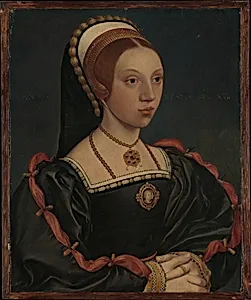
Hans Holbein the Younger, master of the Northern Renaissance, crafted this intimate *Portrait of a Young Woman around 1540–. Working primarily in England as court painter to Henry VIII,bein excelled at capturing the essence of his sitters with unflinching realism and psychological depth. This small oil and gold on oak panel (11⅛ × 9⅛ in.) exemplifies his signature style: precise detailing, subtle modeling of flesh tones, and a sense of poised elegance that reveals the subject's character. The use of gold—likely enhancing jewelry or accents—adds a touch of opulence, underscoring the portrait's role in Tudor-era elite society, where such works served as personal mementos or betrothal gifts. Oak panels were ideal for Holbein's meticulous technique, allowing fine brushwork and luminous effects in oil that brought sitters vividly to life. Though the woman's identity remains unknown, her direct gaze invites viewers into a moment frozen in time. On view in the Metropolitan Museum of Art's European Paintings department (The Jules Bache Collection, 1949), this gem highlights Holbein's influence on portraiture, bridging Flemish precision with emerging Renaissance humanism. A must-see for its technical brilliance and quiet humanity.