
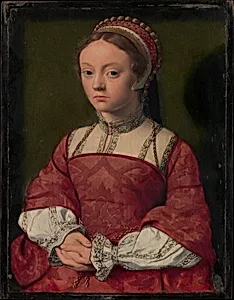
Portrait of a Young Woman
Medium
Oil on wood
Dimensions
10 1/2 x 8 1/4 in. (26.7 x 21 cm)
Classification
Paintings
Department
European Paintings
Museum
Metropolitan Museum of Art, New York, NY
Credit
The Jules Bache Collection, 1949
Accession Number
49.7.32
Rights
Public Domain
Tags
About this artwork
This Portrait of a Young Woman was painted by an unidentified Netherlandish artist between 1530 and 1540, representing the refined portrait tradition of the Northern Renaissance. The small-scale painting reflects the influence of masters working in Antwerp and the Low Countries during this period. The intimate portrait presents a young woman against a dark background, her face turned three-quarters to the viewer with a direct, composed gaze. She wears the fashionable attire of a wealthy middle-...
Art Historical Context
This intimate *Portrait of a Young Woman*, created by an unidentified Netherlandish painter around 1530–1540, exemplifies the refined portrait tradition of the Northern Renaissance. Housed in the Metropolitan Museum of Art as part of The Jules Bache Collection (1949), this small oil-on-wood panel (10½ × 8¼ inches) captures the elegance of Antwerp and Low Countries masters, who catered to prosperous merchants and aristocrats with personalized likenesses for private family collections. The young woman gazes directly at the viewer in three-quarter profile against a dark background, her composed expression framed by fashionable furs and jewelry that signal her middle-class wealth. The artist’s meticulous technique—smooth finishes, precise rendering of skin tones, fabrics, and ornaments—echoes the influence of Joos van Cleve, who worked in England circa 1530, while the pose recalls Hans Holbein. Scholars link it to Antwerp portraitists rather than the Cologne School, highlighting the era’s vibrant Northern European workshops. Oil on wood, perfected by early Netherlandish innovators, allowed for luminous glazes that bring a lifelike glow to the sitter. At this modest scale, such portraits were treasured heirlooms, blending devotional intimacy with social display in a time of rising merchant prosperity.