
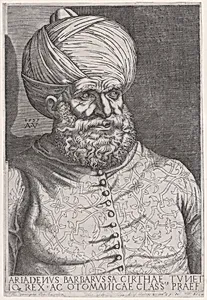
Portrait of Barbarossa
Medium
Engraving
Dimensions
Sheet: 17 5/8 x 12 in. (44.8 x 30.5 cm)
Classification
Prints
Department
Drawings and Prints
Museum
Metropolitan Museum of Art, New York, NY
Credit
The Elisha Whittelsey Collection, The Elisha Whittelsey Fund, 1949
Accession Number
49.95.4
Rights
Public Domain
Tags
Art Historical Context
Step into the Renaissance world of printmaking with Agostino Veneziano's * of Barbarossa* (5), a striking engraving from the Metropolitan Museum Art's Drawings and Prints department. Agostino dei Musi, a leading Venetian engraver active in Rome and Venice, crafted this image on a generous sheet measuring 17⅝ × 12 inches (44.8 × 30.5 cm). Known for his precise reproductive prints after designs by masters like Raphael, Veneziano elevated engraving into a democratic art form, allowing detailed portraits to reach wide audiences beyond elite patrons. The subject, Barbarossa—likely the infamous Ottoman admiral Hayreddin Pasha, scourge of the Mediterranean—embodies the era's geopolitical tensions. In 1535, as Holy Roman Emperor Charles V clashed with Ottoman forces, such portraits fueled European fascination and fear of the "Redbeard" corsair, ally of Sultan Suleiman the Magnificent. Veneziano's technique shines here: fine incisions on a copper plate create rich contrasts, textures in armor and turban, and a commanding gaze, hallmarks of 16th-century Mannerist precision. Acquired in 1949 through The Elisha Whittelsey Fund, this print exemplifies how engravings bridged cultures and conflicts, preserving Barbarossa's legacy in Western collections. A testament to art's power to capture history's bold figures!