
Portrait of Comtesse A. Thibaudeau
1868
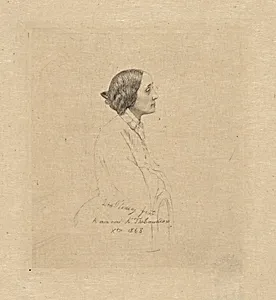
Medium
Engraving
Dimensions
Sheet: 9 5/8 × 6 9/16 in. (24.4 × 16.7 cm)
Classification
Prints
Department
Drawings and Prints
Museum
Metropolitan Museum of Art, New York, NY
Credit
Gift of Howard Mansfield, 1931
Accession Number
31.20.2
Rights
Public Domain
Tags
Art Historical Context
Created in 1868 by the French engraver Léopold Flameng, this delicate portrait captures Comtesse A. Thibaudeau with refined precision. Flameng, active during the nineteenth-century revival of etching and engraving, was celebrated for his technical mastery in translating both original designs and existing paintings into print. Here, the medium allows the subtle modeling of the sitter’s features and attire to emerge through fine lines and tonal gradations, demonstrating how engraving could convey both likeness and status on a modest scale. Measuring just under ten inches in height, the sheet belongs to the tradition of intimate, collectible portrait prints that circulated among European elites and art enthusiasts. Such works offered a more accessible alternative to painted portraits while preserving the dignity and individuality of their subjects. Acquired by the Metropolitan Museum as a gift in 1931, the engraving continues to illustrate the enduring appeal of reproductive and original printmaking in documenting the social world of the Second Empire.
About the Artist
Léopold Flameng · 1831–1911
Léopold Flameng (1831–1911) was one of the most accomplished and influential French engravers of the 19th century, whose exceptional technical mastery and artistic sensitivity made him the preeminent interpreter of paintings by old and modern masters through the medium of engraving. Born in Brussels on November 22, 1831, to French parents, and dying at Courgent, near Paris, on September 5, 1911, F...