
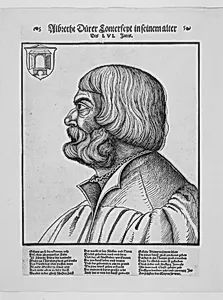
Portrait of Dürer
early 16th century
Medium
Woodcut
Dimensions
sheet: 14 1/4 x 10 1/16 in. (36.2 x 25.6 cm)
Classification
Prints
Department
Drawings and Prints
Museum
Metropolitan Museum of Art, New York, NY
Credit
Gift of Junius Spencer Morgan, 1919
Accession Number
19.73.242
Rights
Public Domain
Tags
Art Historical Context
Created in the early 1500s by German artist Erhard Schön, this woodcut offers a striking profile portrait of Albrecht Dürer, one of the most celebrated figures of the Northern Renaissance. Schön, active in Nuremberg like Dürer himself, worked primarily in printmaking, producing images that captured the likenesses of prominent contemporaries. The medium of woodcut allowed such portraits to be reproduced and shared widely, helping to shape public images of leading artists and intellectuals during a period of rapid cultural change. Measuring roughly 14 by 10 inches, the sheet exemplifies the technical precision required for woodcut printing. Artists carved intricate designs into wooden blocks, which were then inked and pressed onto paper. This labor-intensive process made prints both affordable and portable, spreading Renaissance ideas across Europe far more effectively than unique paintings or drawings could. Housed today in the Metropolitan Museum of Art’s Department of Drawings and Prints, the work reflects the growing interest in artists’ self-fashioning and professional identity. Through its clean lines and dignified profile view, Schön’s woodcut preserves Dürer’s distinctive features while celebrating the era’s innovative print culture.
About the Artist
Erhard Schön · 1491–1542
He was famed as a popular printmaker, with attributions including around 1200 illustrations for 116 books and about 200 separate woodcuts. Among the best works are the woodcuts that he and Hans Springinklee made for the "Hortulus animae", published in Nuremberg in 1515 by Johannes Koberger. It was one of the most popular pre-Reformation anthologies of prayers, published in at least 20 German and L...