
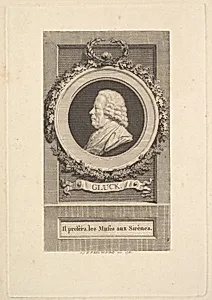
Portrait of Gluck
Medium
Etching and engraving; third state of three (Bocher)
Dimensions
Sheet: 9 1/16 × 6 1/8 in. (23 × 15.6 cm) Plate: 7 1/4 × 4 15/16 in. (18.4 × 12.6 cm)
Classification
Prints
Department
Drawings and Prints
Museum
Metropolitan Museum of Art, New York, NY
Credit
Harris Brisbane Dick Fund, 1917
Accession Number
17.3.756–1473
Rights
Public Domain
Tags
Art Historical Context
This 1781 etching and engraving by Augustin de Saint-Aubin captures the celebrated composer Christoph Willibald Gluck, whose operas had recently taken Paris by storm. Created during the height of the Enlightenment, the portrait reflects the era’s fascination with cultural celebrities and the growing demand for affordable images of notable figures. Saint-Aubin, a skilled French printmaker active in the late eighteenth century, specialized in such intimate yet dignified likenesses that circulated widely among collectors and music enthusiasts. The work’s medium—etching combined with engraving—allowed for fine detail and tonal subtlety, making it ideal for reproducing portraits that conveyed both personality and status. As the third state of three, this impression shows the artist’s final refinements to the plate, demonstrating the meticulous process printmakers used to perfect their images. Measuring just over seven inches in height, the print’s modest scale suited it for inclusion in albums or portfolios, where it could be studied and admired repeatedly. Today housed in the Metropolitan Museum of Art’s collection of drawings and prints, the portrait offers a window into the vibrant musical and artistic life of pre-Revolutionary France. Its presence in the museum’s holdings underscores the enduring appeal of eighteenth-century graphic arts as both documentary records and works of refined craftsmanship.
About the Artist
Augustin de Saint-Aubin · 1736–1807
Comment on works: Illustrator; Engraver