
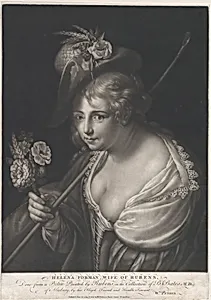
Portrait of Helena Fourment
Medium
Mezzotint
Dimensions
Sheet (Trimmed): 14 × 10 in. (35.6 × 25.4 cm)
Classification
Prints
Department
Drawings and Prints
Museum
Metropolitan Museum of Art, New York, NY
Credit
The Elisha Whittelsey Collection, The Elisha Whittelsey Fund, 1951
Accession Number
51.501.7545
Rights
Public Domain
Tags
Art Historical Context
Behold the enchanting *Portrait of Helena Fourment*, a 1780 mezzotint by English printmaker William Dickinson, after an original painting by the Baroque genius Peter Paul Rubens. Capturing Rubens' second wife, Helena Fourment—a youthful beauty who inspired many of his intimate works—this print dates from the height of the 18th-century fascination with reproducing Old Master paintings through innovative techniques. At 14 × 10 inches, it's a trimmed sheet that invites close admiration of its velvety textures. Rubens (1577–1640), a Flemish luminary of the Baroque era, infused his portraits with sensual vitality, dramatic light, and lush realism, reflecting the opulence of Antwerp's Golden Age. Helena, married to Rubens in 1630 when she was just 16, became his muse, embodying idealized femininity. Dickinson's mezzotint—a "black manner" process invented in the 17th century—revolutionized printmaking by scraping light from a darkened plate, yielding painterly tonal depths ideal for replicating Rubens' sumptuous flesh tones and fur-trimmed elegance. Housed in the Metropolitan Museum of Art's Drawings and Prints department (The Elisha Whittelsey Collection, 1951), this work bridges 17th-century grandeur with Enlightenment-era collecting, offering visitors a tactile glimpse into marital devotion and artistic legacy. A timeless tribute to love and mastery!