
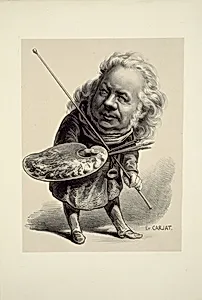
Portrait of Honoré Daumier
1862
Medium
Lithograph in black, with scraping on stone, on light gray China paper laid down using chine collé on white wove paper
Dimensions
Image: 28.1 × 22.7 cm (11 1/8 × 8 15/16 in.); Primary support: 31.2 × 23.5 cm (12 5/16 × 9 5/16 in.); Secondary support: 44.6 × 30.5 cm (17 9/16 × 12 1/16 in.)
Classification
lithograph
Department
Prints and Drawings
Museum
Art Institute of Chicago
Accession Number
105473
Rights
Public Domain
Art Historical Context
In the Prints and Drawings department of the Institute of Chicago, Etienne Carjat's *Portrait of Honoré Daier* (1862) offers a striking lithographic tribute to one of 19th-century France's most incisive artists. Carjat, a skilled photographer and caricaturist, captures Daumier—renowned for his biting social satires—with a direct gaze and expressive features, embodying the era's bohemian intellectual spirit amid the Second Empire's cultural ferment. This work exemplifies advanced lithography, printed in black ink with innovative scraping on the lithographic stone to achieve subtle textures and highlights, evoking a sense of immediacy akin to drawing. The delicate light gray China paper, adhered via chine collé to sturdy white wove support (image: 28.1 × 22.7 cm), underscores the medium's prestige for fine portraiture, allowing rich tonal depth while preserving fragility. Such techniques made lithography accessible yet artistic, bridging commercial printmaking and high art. Daumier's own mastery of the medium makes this portrait a meta-celebration of print culture, highlighting friendships among Paris's avant-garde in 1862—a time when caricature challenged political norms. A testament to Carjat's portrait legacy, it invites visitors to ponder the faces behind France's satirical revolution.
About the Artist
Etienne Carjat · 1828–1906
Étienne Carjat (1828–1906) was a French photographer, caricaturist, and journalist who became one of the defining portraitists of nineteenth-century Parisian cultural life. Born in Fareins in the Ain department, he arrived in Paris as a young man and initially made his name as a caricaturist and writer, contributing to several satirical publications and cofounding the journal Le Boulevard in 1861....