
Portrait of La Baronne de Rebecque
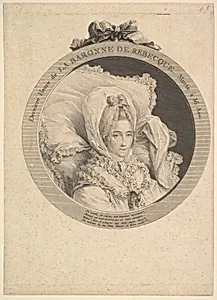
Medium
Etching and engraving; third state of three (Bocher)
Dimensions
Sheet: 11 5/16 × 8 1/16 in. (28.7 × 20.5 cm) Plate: 10 3/8 × 8 in. (26.4 × 20.3 cm)
Classification
Prints
Department
Drawings and Prints
Museum
Metropolitan Museum of Art, New York, NY
Credit
Anonymous Gift, 1924
Accession Number
24.80.247
Rights
Public Domain
Tags
Art Historical Context
Welcome to the Metropolitan Museum of Art's Drawings and Prints collection, where Augustin de Saint-Aubin's *Portrait of La Baronne de Rebec* (1780) captures the elegance of pre-Revolutionary French aristocracy. Created as an etching and engraving—the third state of three, as cataloged by Bocher—this intimate portrait depicts the Baroness, a noblewoman whose poised demeanor reflects the refined world of 18th-century high society. Saint-Aubin, a masteraver from the prolific Saint-Aubin family, was renowned for his precise reproductive prints that translated paintings into accessible yet luxurious works on paper. The medium's significance lies in its technical virtuosity: etching allows for fluid, spontaneous lines, while engraving adds crisp detail and tonal depth, resulting in a delicate balance of texture and light. Measuring about 10 by 8 inches on the plate, this print exemplifies the Rococo-to-Neoclassical transition, blending ornamental grace with emerging restraint. Produced just before the French Revolution, it offers a poignant glimpse into a vanishing era of aristocratic portraiture, where such images served as status symbols and social currency. An anonymous gift to the Met in 1924, this work invites us to ponder the lives of women like the Baroness amid swirling historical tides. A testament to printmaking's democratizing power, it made elite likenesses available beyond oil paintings, preserving her legacy for generations.
About the Artist
Augustin de Saint-Aubin · 1736–1807
Comment on works: Illustrator; Engraver