
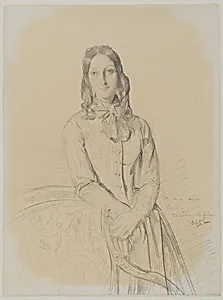
Portrait of Madame Ravaisson
Medium
Graphite on white wove paper darkened to buff
Dimensions
13 1/8 x 10 in. (35.1 x 26.9 cm)
Classification
Drawings
Department
Robert Lehman Collection
Museum
Metropolitan Museum of Art, New York, NY
Credit
Robert Lehman Collection, 1975
Accession Number
1975.1.582
Rights
Public Domain
Tags
Art Historical Context
In the Robert Lehman Collection at The Metropolitan Museum of Art,odore Chassériau *Portrait of Madame Rava* (1846) offers an intimate glimpse into mid-19th-century French portraiture. Crafted when Chassériau was 27, this delicate drawing captures the sitter's refined features with remarkable sensitivity. Rendered in graphite on white wove paper—now softened to a warm buff tone through age—the work measures 13 1/8 x 10 inches, showcasing the artist's early mastery during his formative years in Paris. Chassériau, a prodigy bridging Neoclassicism and Romanticism under the influence of Ingres and Delacroix, excelled in portraits that blended precise linework with emotional depth. Graphite, a versatile dry medium, allowed him to achieve subtle gradations of tone and texture on the smooth wove paper, ideal for studies and finished sheets alike. This technique highlights the era's fascination with personal likenesses among the emerging bourgeoisie, turning everyday subjects into elegant icons. A gem of the Drawings classification, this piece invites visitors to appreciate Chassériau's fluid draftsmanship and the enduring allure of graphite portraits, evoking the quiet sophistication of 1840s salon life.
About the Artist
Théodore Chassériau · 1819–1856
Théodore Chassériau was born on September 20, 1819, in El Limón, Samaná, in the Spanish colony of Santo Domingo — present-day Dominican Republic — to a French father and a Creole mother. The family relocated to Paris in 1820, and the young Chassériau's exceptional talent was evident almost immediately. At just eleven years old, in 1830, he was accepted into the prestigious studio of Jean-Auguste-D...