
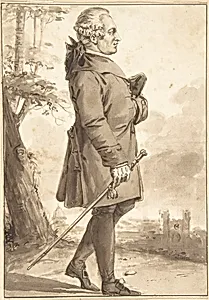
Portrait of P.-A. Caron de Beaumarchais
Medium
Brush and brown wash over graphite underdrawing.
Dimensions
16.8 x 11.7 cm
Classification
Drawings
Department
Drawings and Prints
Museum
Metropolitan Museum of Art, New York, NY
Credit
The Elisha Whittelsey Collection, The Elisha Whittelsey Fund, 1949
Accession Number
49.19.98
Rights
Public Domain
Tags
Art Historical Context
In the Metropolitan Museum of Art's Drawings and Prints department, Jean-Baptiste-François Bosio's *Portrait of P.-A. Caron de Beaumarchais* captures the likeness of one of 18th-century France's most colorful figures. Pierre-Augustin Caron de Beaumarchais (1732–1799), a playwright, watchmaker, and secret agent, penned satirical masterpieces like *The Barber of Seville* and *The Marriage of Figaro*—works that later inspired operas by Rossini and Mozart. Bosio, a neoclassical sculptor and skilled draughtsman active during the Napoleonic era, rendered this intimate portrait in brush and brown wash over graphite underdrawing, a technique favored for its fluid tonal modeling and preparatory precision. Measuring just 16.8 x 11.7 cm, the small-scale drawing highlights Bosio's mastery of wash, where diluted brown ink creates subtle shadows and depth on graphite outlines. This method, common among French artists of the period, bridged drawing and painting, often serving as studies for sculptures or engravings. Its understated elegance reflects neoclassicism's emphasis on clarity and realism. Acquired through The Elisha Whittelsey Fund in 1949, this work offers a glimpse into Beaumarchais's enduring legacy as a Enlightenment-era iconoclast, whose wit and intrigue shaped European culture. Visitors will appreciate its delicate craftsmanship, evoking the vibrancy of pre-Revolutionary Paris.