
Portrait of P.A. Caron de Beaumarchais
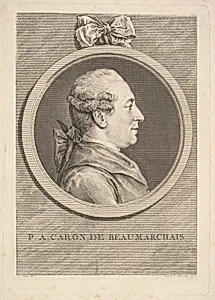
Medium
Etching and engraving; second state of two (Bocher)
Dimensions
Sheet: 9 5/8 × 7 1/2 in. (24.5 × 19 cm) Plate: 7 5/8 × 5 7/16 in. (19.4 × 13.8 cm)
Classification
Prints
Department
Drawings and Prints
Museum
Metropolitan Museum of Art, New York, NY
Credit
Gift of Joseph Verner Reed, 1949
Accession Number
49.125.182
Rights
Public Domain
Tags
Art Historical Context
This elegant etching and engraving, titled *Portrait of P.A.on de Beaumarch*, was crafted in 1773 by the skilled French artists Charles Nicolas Cochin II and Augustin de Saint-Aubin. Cochin II, a leading figure in 18th-century printmaking and a master of Rococo design, collaborated with Saint-Aubin, known for his precise reproductive engravings. The second state of two (as cataloged by Bocher) measures a compact plate size of 7⅝ × 5⁷⁄₁₆ inches, making it an intimate yet widely reproducible portrait ideal for collectors and admirers. The subject, Pierre-Augustin Caron de Beaumarchais (1732–1799), was a multifaceted French polymath—a playwright, watchmaker, publisher, and revolutionary financier—whose satirical comedies like *The Barber of Seville* (1775) and *The Marriage of Figaro* (1778) scandalized and delighted audiences, later inspiring operas by Rossini and Mozart. Captured in 1773, this portrait reflects Beaumarchais at the height of his pre-theatrical fame, amid his ventures in arms dealing for the American Revolution, embodying the Enlightenment spirit of wit and intrigue. Printmaking techniques like etching (for fluid lines) and engraving (for fine detail) were revolutionary for democratizing elite portraits, allowing Beaumarchais's charismatic likeness to circulate beyond oil paintings. Housed in the Metropolitan Museum of Art's Drawings and Prints department (gift of Joseph Verner Reed, 1949), it showcases how 18th-century France blended artistry with cultural celebrity.
About the Artist
Augustin de Saint-Aubin|Charles Nicolas Cochin II · 1736–1807
Comment on works: Illustrator; Engraver