
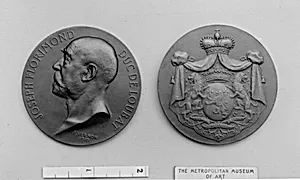
Portrait of the Duke de Loubat
20th century
Medium
Bronze, struck
Dimensions
Diameter: 2 1/4 in. (57 mm)
Classification
Medals and Plaquettes
Culture
French
Department
European Sculpture and Decorative Arts
Museum
Metropolitan Museum of Art, New York, NY
Credit
Gift of Duc de Loubat, 1912
Accession Number
12.63.1a, b
Rights
Public Domain
Tags
About this artwork
This struck bronze medal presents a profile portrait of Joseph Florimond, Duke de Loubat, commemorating the distinguished American expatriate scholar and benefactor. The medal displays the characteristic precision of early twentieth-century French medallic art, with carefully modeled features and elegant lettering. De Loubat's profile is rendered with dignified restraint appropriate to academic portraiture, emphasizing his status as a man of learning and culture. Frédéric-Charles Victor de Verno...
Art Historical Context
This struck bronze medal, measuring just 2¼ inches in diameter, captures a dignified profile portrait of Joseph Florond, Duke de Loubat (1831–1927), an American millionaire turned French citizen and scholar. Created by the acclaimed French medalist Frédéric- Victor de Vernon (1858–1912), it exemplifies the precision and classical elegance of early 20th-century French medallic art. Vernon's profile rendering, with its carefully modeled features and refined lettering, honors de Loubat's status as a patron of archaeology pre-Columbian studies, a rare foreigner elected to France's prestigious Institut de France. Vernon, a Premier Grand Prix de Rome winner in 1887, honed his skills during three years at Rome's Villa Medici, producing commemorative medals for events like scientific anniversaries, international expositions, and the 1900 Paris Olympics. This piece, one of at least two he made for de Loubat (including one for his Institut election), underscores the Duke's pivotal role in Franco-American cultural ties. Gifted to the Metropolitan Museum of Art by de Loubat himself in 1912, it highlights his legacy as a benefactor bridging continents. The bronze striking technique—using precisely cut dies to stamp designs under immense pressure—yields the medal's sharp details and tactile depth, a hallmark of medallic portraiture that blends sculpture with numismatic tradition. A small yet powerful emblem of scholarly prestige.