
Portrait of the Sculptor Hermann Ernst Freund
1837
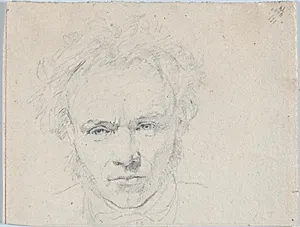
Medium
Graphite; at left and below, framing line in graphite, possibly by the artist
Dimensions
Sheet: 5 1/16 × 6 5/8 in. (12.9 × 16.9 cm)
Classification
Drawings
Department
Drawings and Prints
Museum
Metropolitan Museum of Art, New York, NY
Credit
The Elisha Whittelsey Collection, The Elisha Whittelsey Fund, 2016
Accession Number
2016.675
Rights
Public Domain
Tags
Art Historical Context
Christen Købke's *Portrait of the Sculptor Ernst Freund* (1837) captures a quiet moment of camaraderie among Denmark's artistic elite during the Golden Age of Danish painting. Købke, a leading figure in this era (roughly 1800–1850), was renowned for his luminous portraits and landscapes that celebrated everyday Danish life with poetic realism. Here, he Freund, a prominent neoclassical sculptor and collaborator on Copenhagen's Thorvaldsen, in a sensitive graphite drawing that highlights their shared world of creativity. Rendered on a modest sheet (5 1/16 × 6 5/8 in.), the work showcases Købke's mastery of graphite, employing delicate lines for subtle modeling and texture. The framing line at left and below—likely added by the artist himself—gives it an intimate, sketchbook feel, suggesting this was a personal study rather than a formal commission. Such drawings were vital in the 19th century for artists refining compositions before painting. This piece, now in The Metropolitan Museum of Art's Drawings and Prints department, offers a glimpse into the interconnected lives of Nordic artists. Freund's intense gaze and Freund's thoughtful expression evoke the intellectual fervor of the time, making it a charming window into Denmark's cultural renaissance. Visitors will appreciate its understated elegance and historical warmth.