
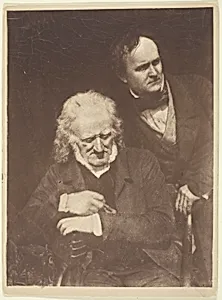
Portrait of Two Men (John Henning and Alexander Handyside Ritchie)
c. 1845, printed 1890/1900
Medium
Carbon print
Dimensions
Image: 21.1 × 15.7 cm (8 5/16 × 6 3/16 in.); Paper: 22.2 × 16.4 cm (8 3/4 × 6 1/2 in.)
Classification
carbon print
Department
Photography and Media
Museum
Art Institute of Chicago
Accession Number
66246
Rights
Public Domain
About this artwork
For more on the Alfred Stieglitz collection at the Art Institute, along with in-depth object information, please visit the website: The Alfred Stieglitz Collection.
Art Historical Context
This striking carbon print by Scottish artist David Octavius Hill captures two men, John Henning and Alexander Handyside Ritchie, in a quietly intimate pose dating to around 1845. Hill, originally a painter, became one of photography’s earliest masters during the medium’s first decade, often collaborating to document Scotland’s artistic and intellectual circles. The image’s soft lighting and natural expressions reflect his sensitive approach to portraiture at a time when long exposure times still demanded stillness and patience from sitters. Although the negative was likely made using the calotype process popular in the 1840s, this particular print was produced decades later as a carbon print between 1890 and 1900. Carbon printing offered richer tonal depth and greater permanence than earlier silver-based methods, helping preserve Hill’s pioneering work for future generations. Today housed in the Art Institute of Chicago’s Photography and Media department, the portrait reminds viewers of photography’s rapid evolution from experimental novelty to respected art form.
About the Artist
David Octavius Hill · 1802–1870
David Octavius Hill (1802–1870) was a Scottish painter, photographer, and arts administrator whose pioneering photography partnership with Robert Adamson from 1843 to 1847 transformed the medium into an art form. Born in Perth and trained in Edinburgh, Hill established himself as a landscape painter and became secretary of the Royal Scottish Academy, a position he held for nearly forty years. His ...