
Portrait of Victor Amédée, roi de Sairdaigne
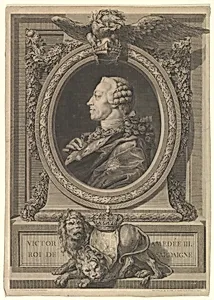
Medium
Etching and engraving; fourth state of four (Bocher)
Dimensions
Sheet: 19 3/16 × 13 11/16 in. (48.7 × 34.7 cm)
Classification
Prints
Department
Drawings and Prints
Museum
Metropolitan Museum of Art, New York, NY
Credit
Purchase, Harry G. Friedman Bequest, 1967
Accession Number
67.539.263
Rights
Public Domain
Tags
Art Historical Context
Welcome to the Metropolitan Museum of's Drawings and Prints collection, where you'll find *Portrait of Victor Améd, roi de Sardaigne* (1777), a striking etching and engraving by French artists Augustin de Saint-Aubin Jean-Baptiste Boucheron. regal portrait depicts Victor Amadeus III, King of Sardinia (r. 1773–1796), during a pivotal era of European monarchy amid Enlightenment ideals and shifting alliances. Produced in the fourth and final state of four (as cataloged by Bocher), it measures an impressive 19 3/16 × 13 11/16 inches, showcasing the meticulous collaboration typical of 18th-century printmaking workshops. Saint-Aubin, renowned for his delicate reproductive engravings, and Boucheron, a skilled etcher, combined techniques to achieve fine lines and rich tonal depth—etching for fluid outlines and engraving for precise detailing. This allowed the print to capture the king's dignified pose, likely with symbolic lions evoking strength and sovereignty, a nod to royal iconography. Prints like this democratized elite portraiture, circulating images of rulers far beyond palace walls and preserving Victor Amadeus III's likeness for posterity. Acquired through the Harry G. Friedman Bequest in 1967, this work highlights the artistry of late Rococo printmaking, bridging personal likeness with political power. A testament to 18th-century technical innovation, it invites you to ponder how images shaped perceptions of kingship.
About the Artist
Augustin de Saint-Aubin|Jean-Baptiste Boucheron · 1736–1807
Comment on works: Illustrator; Engraver