
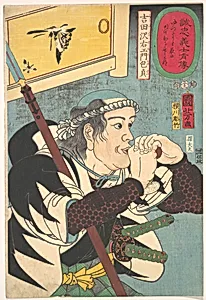
Portrait of Yoshida Sayaemon Kanesada
Medium
Woodblock print; ink and color on paper
Dimensions
H. 14 5/8 in. (37.1 cm); W. 9 7/8 in. (25.1 cm)
Classification
Prints
Culture & Period
Japan · Edo period (1615–1868)
Department
Asian Art
Museum
Metropolitan Museum of Art, New York, NY
Credit
Fletcher Fund, 1929
Accession Number
JP1561
Rights
Public Domain
Tags
Art Historical Context
In the vibrant world of Edo-period Japan (1615–1868), this striking woodblock print from 1852 captures the dignified portrait of Yoshida Sayaemon Kanesada, a figure celebrated in Japanese lore. Created by Utagawa Kuniyoshi, a master of the Utagawa school, in collaboration with Yokogawa Horitake, the artwork exemplifies *musha-e* (warrior prints), a popular genre that romanticized historical heroes, swordsmen, and craftsmen. Measuring 14⅝ × 9⅞ inches, its vertical *ōban* format allowed for dynamic compositions that filled viewers' homes with tales of valor. Kuniyoshi's signature style shines through in the meticulous ink and color on paper, achieved via the collaborative woodblock process where carvers and printers brought the artist's bold lines and vivid hues to life. Yoshida Sayaemon Kanesada, likely depicted with weapons symbolizing his legendary swordsmithing prowess, embodies the samurai ethos of skill and honor amid Japan's feudal era. Such prints were affordable art for the masses, bridging elite history with everyday appreciation. Housed in the Metropolitan Museum of Art's Asian Art Department (Fletcher Fund, 1929), this piece highlights ukiyo-e's cultural role in preserving Japan's warrior heritage just before the Meiji Restoration upended traditional society. A testament to artistry and endurance, it invites us to admire the fusion of portraiture, weaponry, and national pride.
About the Artist
Yokogawa Horitake|Utagawa Kuniyoshi ( |Japanese) · |1797 – |1861
|Japanese, 1797–1861