
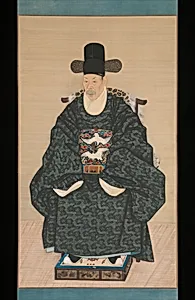
윤동섬 초상 조선|尹東暹肖像 朝鮮|Portrait of Yun Dongseom (1710–1795)
ca. 1790–1805
Medium
Hanging scroll; ink and color on silk
Dimensions
Image: 52 3/8 × 30 3/8 in. (133 × 77.2 cm) Overall with mounting: 76 × 31 in. (193 × 78.7 cm) Overall with knobs: 76 × 33 1/4 in. (193 × 84.5 cm)
Classification
Paintings
Culture & Period
Korea · Joseon dynasty (1392–1910)
Department
Asian Art
Museum
Metropolitan Museum of Art, New York, NY
Credit
Purchase, Harris Brisbane Dick and 2014 Benefit Funds; Friends of Korean Art, Locks Foundation, Hyun Jun M. Kim, and Tchah Sup and Myong Hi Kim Gifts, 2014
Accession Number
2014.605
Rights
Public Domain
Tags
Art Historical Context
This formal portrait depicts a seated Korean official in three-quarter view, dressed in a voluminous dark green robe patterned with subtle cloud motifs and fastened with a wide belt. A vibrant rectangular insignia on his chest features a white crane in flight amid colorful flowers while his black horsehair hat and white under-collar complete the formal attire. His hands rest on his knees, and his feet, clad in patterned shoes, rest on an ornate lacquered footstool. The figure is rendered with delicate brushwork in ink and color on silk, set against a plain, luminous background that emphasizes the sitter’s presence. Created by an unidentified artist during the late Joseon dynasty, this hanging scroll portrays Yun Dongseom, a scholar-official who lived from 1710 to 1795. Such portraits were commissioned to honor distinguished individuals and preserve their likeness for posterity, reflecting the Confucian values of respect for learning and public service that shaped Korean society at the time. The crane emblem on the robe signifies high rank and longevity, common symbols in official imagery of the period. The work’s refined technique and measured composition exemplify the restrained elegance characteristic of Joseon court painting, where every detail conveys status and moral authority without unnecessary ornament.