
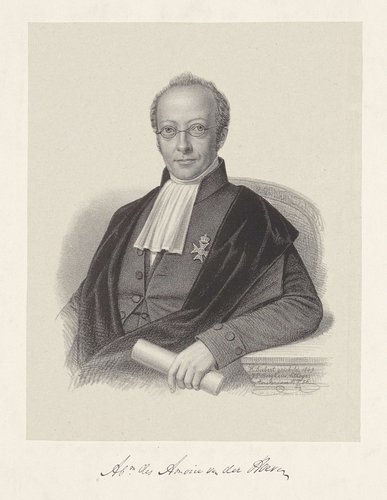
Portret van Abraham des Amorie van der Hoeven
1856-01-19
Medium
lithography
Dimensions
411; 320
Rights
Public Domain
About this artwork
De geportretteerde draagt een bril, een witte bef en een ridderorde op zijn borst. In zijn linkerhand heeft hij een opgerold stuk papier. Onder het portret zijn signatuur. Naar een schilderij van Heinrich Siebert.
Art Historical Context
**Portrait of Abraham des Amorie van der Hoeven** This striking 1856 lithograph by Johann Peter Berghaus captures the dignified likeness of Abraham des Amorie van der Hoeven, a prominent figure likely from Dutch high society. Rendered after an original painting by Heinrich Siebert, the portrait measures 411 × 320 mm and exemplifies mid-19th-century portraiture's focus on status and intellect. Berghaus, a skilled German-Dutch lithographer, faithfully translates Siebert's composition, including the sitter's signature beneath the image, preserving the painting's essence through this reproductive medium. Des Amorie van der Hoeven gazes directly at the viewer, bespectacled and adorned with a crisp white ruff collar—a nod to historical fashion—and a knight's order pinned to his chest, symbolizing noble achievements or civic honors. In his left hand, he clasps a rolled document, evoking authority, perhaps a diploma or legal scroll, common motifs in bourgeois portraits of the era. Lithography's greasy crayon technique allowed for subtle tonal gradations, making fine details like fabric textures and metallic gleam accessible to a wider audience via affordable prints. In the 1850s, such works bridged elite painting and public dissemination, reflecting Europe's growing middle class and fascination with personal legacy. This piece offers a window into Victorian-era formality and the era's print revolution.