
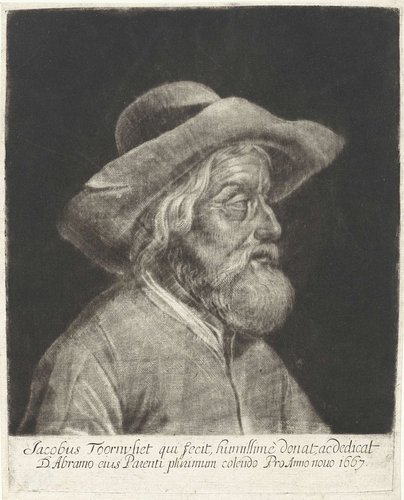
Portret van Abram Toorenvliet
Medium
paper
Dimensions
140; 175
Rights
Public Domain
About this artwork
mezzotint
Art Historical Context
**Portret van Abram Toorenvliet** (1667) is a intimate portrait by Dutch artist Jacob Toorenvliet, capturing his father, Abram Toorenvliet, a fellow painter from Leiden. Created during the Dutch Golden Age—a flourishing era of artistic innovation—this small-scale work (175 × 140 mm) exemplifies period's emphasis on realistic portraiture and family legacy in art. Jacob, known for his genre scenes and meticulous still lifes, here honors his progenitor, reflecting the close-knit artistic communities of 17th-century Holland where skills were often passed down generations. The standout feature is its medium: mezzotint on paper, a revolutionary intaglio printmaking technique pioneered just decades earlier around 1650. Unlike traditional engraving's sharp lines, mezzotint begins with a roughened copper plate to produce deep, velvety blacks and subtle tonal gradations, mimicking oil painting's richness. This allowed for soft modeling of flesh tones and dramatic lighting, making it ideal for expressive portraits. Toorenvliet's adoption of mezzotint highlights its rapid popularity among Dutch and English artists for affordable, high-quality reproductions. This piece offers a window into the Toorenvliet family's artistic world, showcasing technical prowess and personal devotion. Its compact size suggests it was perhaps a private treasure or study, inviting visitors to appreciate the tactile depth of mezzotint up close in our virtual gallery.
About the Artist
Jacob Toorenvliet · 1635–1719
**Jacob Toorenvliet (1640–1719)** Jacob Toorenvliet was baptized on 1 July 1640 in Leiden, in the Dutch Republic, the son of Abraham Toorenvliet, a prominent glass painter, drawing master, and member of both the Glassmakers’ Guild and the Guild of Saint Luke. He learned the rudiments of painting from his father, who also instructed artists like Frans van Mieris the Elder and Matthijs Naiveu, befo...