
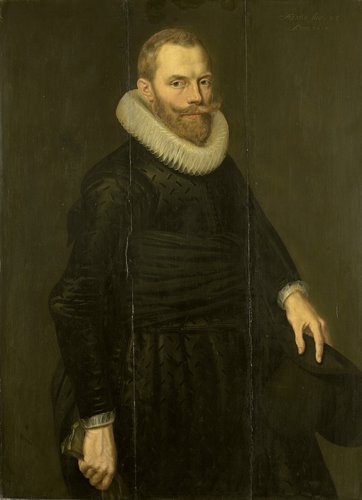
Portret van Dirck Hasselaer (1581-1645)
Medium
oil on panel
Dimensions
82.8; 114.6; 8
Rights
Public Domain
About this artwork
label, op de achterzijde van het schilderij: ‘Bregje van Schoterbosch / vrouwe van Dirk Hasselaar: / Vader en Moeder van Aagje Hasselaar / vrouwe van Henrick Hooft. / Vader en Moeder van Bregje van de Poll, / vrouwe van Harman van de Poll’
Art Historical Context
**Portrait of Dirck Hasser (1581-1645)** *Cornelis van der Voort 1614, oil on panel, 114.6 × 828 cm* Step into the early Dutch Golden Age with this striking portrait by Cornelis van der Voort, a master of Amsterdam's burgeoning portrait tradition. Painted in 1614, it captures Dirck Hassela, a notable figure whose life spanned the vibrant merchant republic's rise. Van der Voort, active from 1603 to 1624, specialized in formal likenesses of the city's elite burghers, blending Flemish influences with a crisp Dutch realism that foreshadowed Rembrandt's era. The oil on panel medium—durable and ideal for intricate details—brings out the textures of fine clothing and the subject's dignified pose, typical of half-length portraits commissioned to affirm status. A fascinating label on the painting's reverse adds layers of family history: it identifies Bregje van Schoterbosch as "vrouwe van Dirk Hasselaar" (wife of Dirck Hasselaer), noting their daughters Aagje (wife of Henrick Hooft) and Bregje van de Poll (wife of Harman van de Poll). This inscription reflects 17th-century Dutch customs, where such genealogical notes preserved lineage among prosperous families intertwined with Amsterdam's regent class. Housed in the Rijksmuseum, the work highlights how portraiture served as both personal memento and social document, celebrating the era's economic and cultural flowering.