
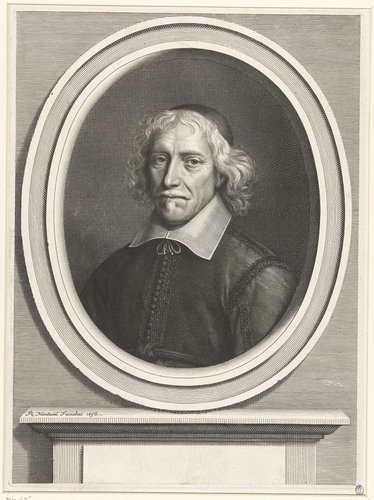
Portret van Gilles Boileau
1658
Medium
engraving
Dimensions
343; 253
Rights
Public Domain
About this artwork
plaatrand: hoogte 343 mm x breedte 253 mm
Art Historical Context
Behold Robert Nanteuil's *Portret van Gilles Boileau* (1658), a engraving that captures the elegance of 17th-century French portrait. Measuring 343 mm in height and mm in width—substantial dimensions for a print its era—this work depicts Boileau, likely notable figure from the intellectual official circles of Louis XIV early reign. Nante, a leading French engr (1623–1678 produced this piece at height of his career, renowned for his ability to translate the subtleties of oil paintings into intricate prints. Engraving, Nanteuil's chosen medium, involved meticulously inc lines into a copper plate with a burin, creating rich tonal variations and lifelike textures through ink and pressure. This technique was revolutionary for its time, allowing high-quality reproductions that democratized access to elite portraits, bridging the gap between courtly sitters and a wider audience. Nanteuil's style exemplifies the refined Baroque portraiture of the French school, emphasizing psychological depth and aristocratic poise. In the cultural landscape of 1658, amid France's artistic golden age, such engravings served as status symbols and historical records, preserving the likenesses of influential men like Boileau. This plate's precise borders and scale highlight Nanteuil's technical virtuosity, making it a gem for admirers of printmaking's golden era.
About the Artist
Robert Nanteuil · 1623–1678
Robert Nanteuil (1623-1678) was a French portrait engraver, draughtsman, and pastellist who became the preeminent portraitist to the court of Louis XIV. His technical mastery and royal patronage fundamentally transformed the status of engraving in France, elevating it from a mechanical craft to a recognized fine art. Nanteuil stands as the outstanding French portrait engraver of the seventeenth c...