
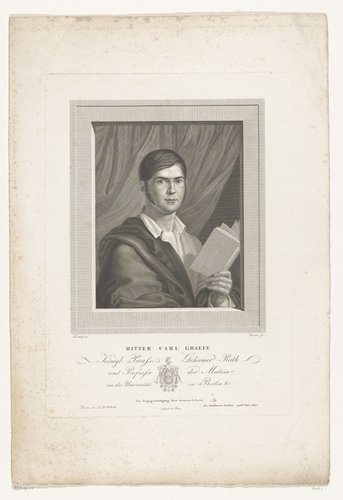
Portret van Karl Ferdinand Gräfe
in or before 1819-03
Medium
engraving
Dimensions
310; 220
Rights
Public Domain
About this artwork
gravure
Art Historical Context
"Portret van Karl Ferdinandäfe" is a striking engraving by C. Büscher, created in or before March 1819. Measuring 310 mm high by 220 mm wide, this portrait captures the likeness of Karl Ferdinand von Grfe, a pioneering German surgeon renowned for his advancements in plastic surgery and ophthalmology during the early 19th century. As one of the first to perform successful cleft palate repairs and skin grafts, Gräfe image reflects the era's growing fascination with medical luminaries, immortalized through printmaking for wide dissemination. Engraving, the medium here—known as *gravure* in Dutch—allowed for intricate details in line work and shading, making it ideal for reproducing portraits with precision. Büscher, likely a skilled printmaker of the Romantic period, employed techniques like burin incisions on a metal plate to achieve fine textures in Gräfe's features, attire, and dignified pose. This process not only ensured durability for multiple impressions but also democratized access to images of influential figures, bridging art and science. In the context of early 19th-century Europe, such portraits underscored the Enlightenment's legacy, blending portraiture with emerging professional identities. Visitors will appreciate how this modest yet masterful print highlights the intersection of artistry and medical history, offering a window into a transformative time.