
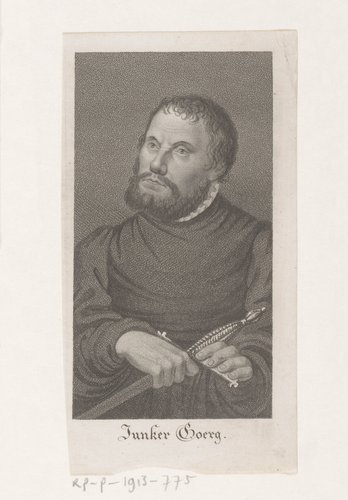
Portret van Martin Luther
Medium
stipple engraving
Dimensions
140; 72
Rights
Public Domain
About this artwork
stippelgravure
Art Historical Context
**Portret van Martin Luther** is a delicate stipple engraving created by Friedrich Wilhelm Meyer (I) in 1817, measuring just 140mm by 72mm—perfectly sized for a collector's album or scholarly volume. This intimate portrait captures the likeness of Martin Luther, the seminal 16th-century reformer whose Ninety-Five Theses ignited the Protestant Reformation, challenging the Catholic Church and reshaping European Christianity. Meyer employs the stipple engraving technique, or *stippelgravure*, where intricate patterns of dots produce subtle gradations of tone and texture, mimicking the softness of painting. Popular in the late 18th and early 19th centuries, this method excelled in reproductive prints, allowing widespread dissemination of revered figures' images without losing nuanced expression. Its fine detail would have appealed to Enlightenment-era audiences valuing precision and historical fidelity. Produced over 250 years after Luther's death, this work underscores his enduring cultural icon status amid 19th-century religious and nationalistic revivals in German-speaking regions. A testament to printmaking's role in preserving legacy, it invites visitors to ponder how such tiny engravings fueled Reformation memory across generations.