
Portsmouth Point
Medium
Hand-colored etching on ivory wove paper
Dimensions
Image: 23 × 33.5 cm (9 1/16 × 13 1/4 in.); Plate: 24.5 × 35.3 cm (9 11/16 × 13 15/16 in.); Sheet: 26 × 39.3 cm (10 1/4 × 15 1/2 in.)
Classification
etching
Department
Prints and Drawings
Museum
Art Institute of Chicago
Accession Number
44615
Rights
Public Domain
Art Historical Context
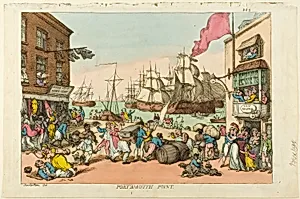
Portsmouth Point, a hand-colored etching created in 1814 by British artist Thomas Rowlandson, invites viewers into the energetic world of a key English naval harbor. Rowlandson, known for his satirical prints and caricatures of Georgian-era life, used lively line work to capture social scenes with humor and keen observation. This print, now in the Art Institute of Chicago, exemplifies etching—a process of incising detailed images onto a metal plate for reproduction—enhanced by hand-coloring that added warmth and immediacy to the ivory wove paper. Produced amid the Napoleonic Wars, the work reflects Portsmouth’s role as a bustling maritime hub, where sailors, townsfolk, and everyday activity mixed in a lively port setting. Prints like this made contemporary British life accessible to a broad audience, blending artistic skill with cultural commentary. Rowlandson’s style, rooted in caricature, highlights the era’s social energy without needing grand historical narratives. Today, the piece stands as a window onto early 19th-century Britain, showcasing how printmaking preserved fleeting moments of human drama and naval importance for later generations.
About the Artist
Thomas Rowlandson · 1756–1827
Thomas Rowlandson (1757–1827) was an English artist and caricaturist whose satirical watercolors and prints captured the social life of Georgian Britain with unparalleled wit and technical mastery. Alongside James Gillray, he is recognized as one of the greatest British graphic artists, and his distinctive flowing line and keen observations have made his work integral to understanding late 18th an...