
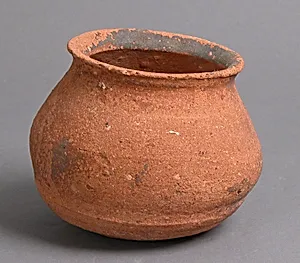
Pot
Unknown Artist
4th–7th century
Medium
Earthenware
Dimensions
Overall: 3 7/8 x 4 13/16 in. (9.8 x 12.2 cm)
Classification
Ceramics
Culture
Coptic
Department
Medieval Art
Museum
Metropolitan Museum of Art, New York, NY
Credit
Rogers Fund, 1925
Accession Number
25.10.23.94
Rights
Public Domain
Art Historical Context
This modest earthenware pot, crafted by an unknown Coptic artisan between the 4th and 7th centuries, offers a glimpse into the everyday life of early Christian Egypt. Measuring just 3 7/8 x 4 13/16 inches (9.8 x 12.2 cm), its compact form suggests it was used for practical purposes—perhaps storing grains, oils, or water in households across the Nile Valley. Acquired through the Rogers Fund in 1925, it now resides in the Metropolitan of Art's Medieval Art, classified among Coptic ceramics. Coptic culture emerged as Christianity took root in Egypt during late antiquity, blending ancient Egyptian traditions with Byzantine influences under Roman and early Islamic rule. Earthenware like this was a staple medium, hand-formed and low-fired for durability in domestic settings. Though unglazed and unadorned, its survival highlights the resilience of Coptic craftsmanship amid a transformative era, when monastic communities flourished and distinct Christian identities formed. For visitors, this unassuming pot underscores how museum treasures often reveal the unsung rhythms of history—simple objects that carried the daily sustenance of a vibrant, faith-filled society.