
Pot
Unknown Artist
4th–7th century
Medium
Earthenware
Dimensions
Overall: 3 7/8 x 4 5/8 in. (9.8 x 11.7 cm)
Classification
Ceramics
Culture
Coptic
Department
Medieval Art
Museum
Metropolitan Museum of Art, New York, NY
Credit
Rogers Fund, 1925
Accession Number
25.10.20.140
Rights
Public Domain
Art Historical Context
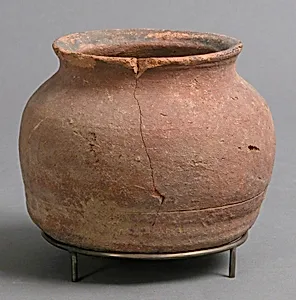
This modest earthenware pot, crafted by an unknown Coptic artist between the 4th and 7th centuries, offers a glimpse into the everyday life of early Christian Egypt. Measuring just under 4 inches tall and wide, it exemplifies the practical ceramics produced in Coptic workshops during Late Antiquity, a time when Christianity flourished in Egypt under Roman and Byzantine rule. Acquired through the Rogers Fund in 5 and housed in the Museum of Art's Medieval department, this vessel highlights the Copts'—native Egyptian Christians—blend of ancient Egyptian traditions with emerging Christian influences. Coptic pottery like this pot was essential for storage, cooking, and rituals in households and monasteries, reflecting a resilient culture amid political shifts, including the Arab conquest by the 7th century. Earthenware, fired at relatively low temperatures, was abundant and durable, often wheel-thrown for symmetry and efficiency. Though undecorated, its simple, rounded form speaks to functional artistry, prioritizing utility over ornamentation in a society valuing monastic simplicity. Today, such artifacts illuminate the material world of Coptic Egypt, bridging pagan pasts and Christian futures. Visitors can appreciate how this unassuming pot captures the ingenuity of anonymous makers whose work sustained a vibrant spiritual heritage.