
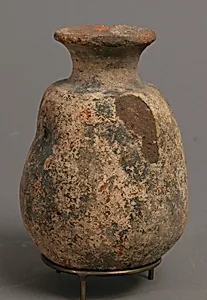
Pot
Unknown Artist
4th–7th century
Medium
Earthenware
Dimensions
Overall: 4 13/16 x 3 5/16 in. (12.2 x 8.4 cm)
Classification
Ceramics
Culture
Coptic
Department
Medieval Art
Museum
Metropolitan Museum of Art, New York, NY
Credit
Rogers Fund, 1925
Accession Number
25.10.20.157
Rights
Public Domain
Art Historical Context
This modest earthenware pot, crafted by an unknown Coptic artisan between the 4th and 7th centuries, offers a glimpse into the daily life of early Christian Egypt. Measuring just 4 13/16 x 3 5/16 inches (12.2 x 8.4 cm), its small, practical form suggests it was used for storing grains, oils, or water in households across the Nile Valley. Earthenware, made from fired clay without glaze, was a staple medium in Coptic ceramics—affordable, durable, and on a potter's wheel or by hand, reflecting the continuity of ancient Egyptian pottery traditions adapted to a Christian era. Coptic culture emerged as Egypt transitioned from pharaonic paganism to Christianity under Roman and Byzantine rule, blending local craftsmanship with emerging monastic influences. This pot, classified among Medieval Art ceramics at The Metropolitan Museum of Art (acquired via the Rogers Fund in 1925), exemplifies the unadorned functionality of everyday objects from this formative period. Though simple, it highlights the resilience of Coptic communities, whose art and artifacts bridged late antiquity and the early Middle Ages, preserving techniques honed over millennia. Today, such vessels remind us that art history thrives not only in grand monuments but in the quiet tools of ordinary lives, inviting us to ponder the hands that shaped them.