
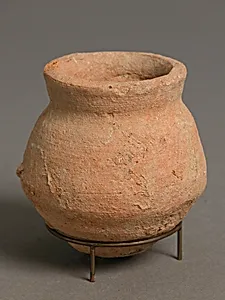
Pot
Unknown Artist
4th–7th century
Medium
Earthenware
Dimensions
Overall: 2 5/16 x 2 3/16 in. (5.9 x 5.5 cm)
Classification
Ceramics
Culture
Coptic
Department
Medieval Art
Museum
Metropolitan Museum of Art, New York, NY
Credit
Rogers Fund, 1925
Accession Number
25.10.24.27
Rights
Public Domain
Art Historical Context
This delicate earthenware pot, crafted by an unknown Coptic artist between the 4th and 7th centuries, offers a glimpse into everyday life in early Christian Egypt. Measuring just 2 5/16 x 2 3/16 inches (5.9 x 5.5 cm), its modest size suggests it may have held oils, spices, or small provisions, reflecting the practical needs of Coptic households during a time of cultural transition. Coptic culture emerged in Egypt following the spread of Christianity in the late Roman Empire, blending ancient Egyptian traditions with Byzantine influences. Placed in the Medieval Art department The Metropolitan Museum of Art (acquired through the Rogers Fund in 1925), this ceramic vessel highlights the resilience of local craftsmanship amid religious and political shifts, including the Arab conquest by the 7th century. Such pots were ubiquitous in monastic and domestic settings, underscoring the Copts' devotion to simple, functional beauty. Earthenware, fired at low temperatures without glaze, was prized for its affordability and versatility, allowing mass production via wheel-throwing or molding techniques. Though unadorned, its survival speaks to the enduring quality of Coptic pottery, preserving a tangible link to a vibrant, faith-driven society. Visitors, imagine this tiny pot gracing a Nile Valley home— a quiet testament to lives long past.