
Pot Trivets
c. 1938
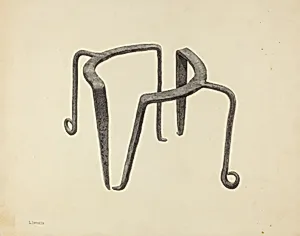
Medium
graphite on paperboard
Dimensions
overall: 32.7 x 41.4 cm (12 7/8 x 16 5/16 in.) Original IAD Object: 7" high; 7 1/4" wide
Classification
Index of American Design
Department
CG-W
Museum
National Gallery of Art, Washington, D.C.
Credit
Index of American Design
Accession Number
1943.8.15867
Rights
Public Domain
Art Historical Context
**Pot Trivets**, a meticulous graphite drawing on paperboard by Salvatore Borzo from around 1938, captures the yet essential form of American pot trivets—sturdy stands designed to elevate cookware over heat sources. Measuring 32.7 x 41.4 cm, this work renders a small original object (7 inches high by 7¼ inches wide) with remarkable precision, highlighting its functional geometry and subtle craftsmanship typical of everyday American folk objects. Created as part of the Index of American Design, a Federal Art Project under the Works Progress Administration (WPA) from 1935 to 1942, Borrazzo's rendering preserves the aesthetic and utilitarian legacy of pre-industrial American design. During the Great Depression, this ambitious initiative employed artists to document thousands of regional crafts, from tools to textiles, ensuring cultural heritage endured economic hardship. Borrazzo's graphite technique excels in fine lines and shading, conveying texture and form with scientific accuracy—much like a modern blueprint for historical artifacts. Housed in the National Gallery of Art's Index collection, this piece invites visitors to appreciate how ordinary kitchen tools embodied American ingenuity and resourcefulness.
About the Artist
Salvatore Borrazzo · 1916–1964
Salvatore Borrazzo is an artist whose biographical details are only partially recoverable from the available historical record. His dates, precise nationality, training, and the full extent of his artistic production have not been firmly established in the scholarly sources currently accessible, placing him among the many artists whose names appear in collection and exhibition records but whose li...