
Pottery Whistle
Unknown Artist
ca. 300–900
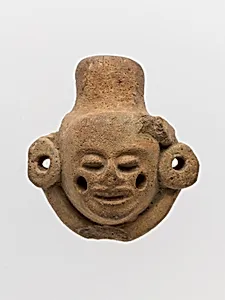
Medium
Clay
Dimensions
L. 61 mm.; W. 57 mm.; D. 37 mm.; Wt. 49 g.
Classification
Aerophone-Whistle Flute-whistle
Culture & Period
Mexican · Pre-Columbian
Department
Musical Instruments
Museum
Metropolitan Museum of Art, New York, NY
Credit
The Crosby Brown Collection of Musical Instruments, 1889
Accession Number
89.4.2378
Rights
Public Domain
Tags
Art Historical Context
This charming Pottery Whistle, crafted from clay by an unknown artist in Pre-Columbian Mexico around300–900 CE, the ingenuity of ancient Mesoamerican artisans. Measuring just 61 mm long, 57 mm wide, and 37 mm deep, this lightweight (49 g) aerophone—classified as a whistle flute—fits comfortably in the hand. Its compact form suggests it was designed for personal or ritual use, producing sound when air is blown across an opening, much like modern ocarinas. The whistle's creation highlights advanced pottery techniques of the era, where clay was molded, fired, and possibly decorated to form functional art. The tag "Heads" hints at a figurative design, perhaps portraying a human or animal head, a common motif in Pre-Columbian artifacts symbolizing spirits, ancestors, or deities. Such instruments bridged the worlds of music, ceremony, and daily life, possibly used in rituals, festivals, or as toys for children. Housed in the Metropolitan Museum of Art's Crosby Brown Collection of Musical Instruments (acquired 1889), this piece offers a window into Mexico's vibrant pre-Hispanic cultures, showcasing how sound and form intertwined in everyday spirituality and artistry. Visitors, imagine the haunting tones echoing through ancient plazas!