
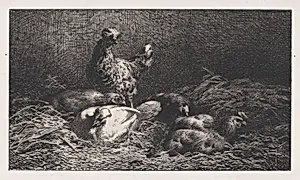
Poules
1867
Medium
Drypoint
Dimensions
Sheet: 12 3/16 × 18 3/4 in. (30.9 × 47.7 cm) Plate: 5 13/16 × 9 3/16 in. (14.7 × 23.4 cm) Image: 4 3/4 × 8 1/4 in. (12 × 20.9 cm)
Classification
Prints
Department
Drawings and Prints
Museum
Metropolitan Museum of Art, New York, NY
Credit
Harris Brisbane Dick Fund, 1927
Accession Number
27.10.67
Rights
Public Domain
Tags
Art Historical Context
Charles Jacque’s 1867 drypoint *Poules* offers an intimate glimpse of rural life through its depiction of hens. Working in a modest plate size of roughly 5 13/16 by 9 3/16 inches, Jacque captures the birds with lively, textured lines that convey both their feathered forms and the quiet activity of a farmyard. The print’s compact scale invites close looking, rewarding viewers with subtle details of posture and movement. Drypoint, an intaglio technique in which the artist scratches directly into a metal plate, produces characteristically soft, velvety lines from the raised burr of displaced metal. This medium suited Jacque’s interest in animal subjects, allowing him to suggest the fluffiness of feathers and the play of light without heavy reliance on color. Acquired by the Metropolitan Museum through the Harris Brisbane Dick Fund in 1927, the sheet remains a fine example of nineteenth-century printmaking that brought evocative scenes of the countryside to a wider audience.
About the Artist
Charles Jacque · 1813–1894
Charles-Émile Jacque (1813–1894) was a pioneering French painter, engraver, and illustrator whose career bridged the worlds of printmaking and pastoral painting. Born in Paris amid a difficult childhood, he apprenticed at age seventeen to a map engraver, mastering drypoint technique and producing his first etching in 1830—a copy of a head after Rembrandt. After serving seven years in the French Ar...