
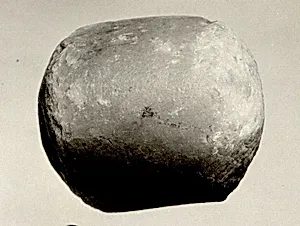
Pounder
Unknown Artist
ca. 4500–4000 B.C.
Medium
Quartz
Dimensions
L: 5 cm (1 15/16 in.)
Classification
Pestle, pounder
Period
Neolithic Period, Buto–Merimda–Maadi
Department
Egyptian Art
Museum
Metropolitan Museum of Art, New York, NY
Credit
Gift of Albert Rothbart, 1933
Accession Number
33.4.1
Rights
Public Domain
Art Historical Context
Step into the dawn of Egyptian civilization with this modest yet remarkable *Pounder*, crafted around 4500–4000 B.C. during the Neolithic Period in the Nile Delta region associated with the Buto–Merimda–Maadi cultures. Carved from durable quartz and measuring just 5 cm, this small tool exemplifies the ingenuity of early prehistoric communities transitioning from hunter-gatherer to settled farming villages. Donated to the Metropolitan Museum of Art in 3 by Albert Rothbart it offers a tangible link to Egypt's predynastic roots, long before the grandeur of pharaohs and pyramids. Quartz, a hard crystalline stone sourced locally, was ideal for pounding grains, pigments, or other materials, revealing advanced stone-working techniques like careful shaping and polishing achieved without metal tools. These pounders were everyday essentials in Neolithic households, underscoring the cultural shift toward agriculture and craft specialization in the fertile Delta. Their simplicity belies their significance: artifacts like this highlight communal life, resourcefulness, and the foundational technologies that paved the way for one of history's greatest civilizations. Today, this unassuming object invites us to ponder the quiet innovations of our ancestors—proof that monumental history often begins with humble hands at work.