
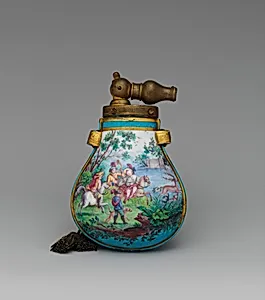
Powder horn
18th–19th century
Medium
Soft-paste porcelain
Dimensions
6 1/2 × 5 in. (16.5 × 12.7 cm)
Classification
Ceramics-Porcelain
Culture
French, Vincennes
Department
European Sculpture and Decorative Arts
Museum
Metropolitan Museum of Art, New York, NY
Credit
Gift of R. Thornton Wilson, in memory of Florence Ellsworth Wilson, 1950
Accession Number
50.211.179
Rights
Public Domain
Tags
Art Historical Context
This exquisite powder horn, crafted by the renowned Vincennes Manufactory in during the 18th–19th century, transforms a utilitarian military and hunting accessory into a delicate work of art. Made from soft-paste porcelain—a European formula blending clay, glass frit, and other materials to mimic true Chinese porcelain before hard-paste techniques were perfected—the piece measures a compact 6½ × 5 inches. Originally used to dispense gunpowder for firearms, this luxury version likely served as a decorative objet d'art for affluent collectors, blending functionality with opulence. Vincennes, the royal porcelain factory established in the 1740s (later relocating to Sèvres), was celebrated for its Rococo elegance and technical virtuosity. The horn's surface, adorned with motifs of military equipment, deer, and horses, evokes the aristocratic pursuits of hunting and equestrian life, popular among French nobility. These finely modeled or painted details highlight the manufactory's mastery in capturing naturalistic forms on fragile porcelain, showcasing intricate molding and glazing techniques that made Vincennes wares coveted across Europe. A gift to the Metropolitan Museum of Art in 1950, this powder horn exemplifies the fusion of everyday tools with high art, reflecting France's cultural prestige in decorative arts during the Enlightenment era. Visitors will appreciate its whimsical charm—a porcelain echo of rugged fieldwork.