
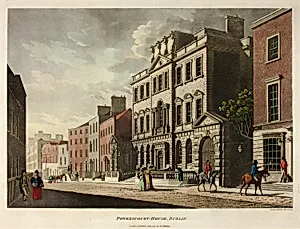
Powerscourt House, Dublin
published July 1795
Medium
Hand-colored aquatint in black on ivory wove paper
Dimensions
Image: 26.7 × 38.3 cm (10 9/16 × 15 1/8 in.); Plate: 31.5 × 42.5 cm (12 7/16 × 16 3/4 in.); Sheet: 42 × 55.5 cm (16 9/16 × 21 7/8 in.)
Classification
aquatint
Department
Prints and Drawings
Museum
Art Institute of Chicago
Accession Number
127944
Rights
Public Domain
Art Historical Context
Step into the elegant world 18th-century Dublin with James Malton's *Powerscourt House, Dublin*, hand-colored aquatint in July 1795 Malton, an accomplished artist and architect, captured the grandeur of this neoclassical townhouse on South William Street, a symbol of aristocratic refinement during Ireland's Georgian era. Built in the 1770s for Powerscourt, the house exemplified Palladian symmetry and opulence, reflecting the prosperity of Dublin's elite amid political tensions leading to the Act of Union in 1801. This print showcases aquatint's innovative technique—a form of intaglio printing that uses acid-resistant resin to create soft, tonal gradations mimicking watercolor washes. Hand-coloring on ivory wove paper adds vivid life to the architecture's warm stone facades, manicured gardens, and bustling street scene, making it both a precise architectural record and a picturesque souvenir. Measuring 26.7 × 38.3 cm, it belongs to Malton's seminal series *A Picturesque and Descriptive View of the City of Dublin* (1792–1799), preserving vanishing urban vistas. Housed in the Art Institute of Chicago's Prints and Drawings department, this work highlights printmaking's role in democratizing art, allowing collectors across Europe to own a slice of Ireland's cultural heritage. A testament to Malton's meticulous eye, it invites us to appreciate how images like this bridged art, history, and memory.