
Prayer Rug
Unknown Artist
late 16th century
Medium
Silk, wool; asymmetrically knotted thread
Dimensions
Rug: H. 71 in. (180.34 cm) W. 44 in. (111.76 cm) Mount: H. 78 3/4 in. (200 cm) W. 52 1/2 in. (133.4 cm) D. 2 3/8 (6 cm)
Classification
Textiles-Rugs
Department
Islamic Art
Museum
Metropolitan Museum of Art, New York, NY
Credit
Bequest of Joseph V. McMullan, 1973
Accession Number
1974.149.1
Rights
Public Domain
Tags
Art Historical Context
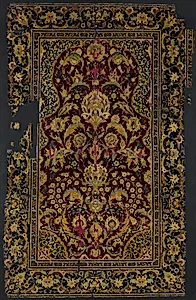
This exquisite Prayer Rug, crafted by an unknown artist in the 16th century, hails from the Islamic world during a golden age of textile artistry, likely the Ottoman Empire or Persia. Measuring about 71 by 44 inches, it was designed for personal devotion, with its characteristic mihrab—a pointed arch at the top—symbolizing niche in a mosque that directs worshippers toward Mecca. Such rugs transformed everyday prayer into a portable sacred space, reflecting the deep piety and craftsmanship of Muslim artisans. Woven from luxurious silk and wool using an asymmetrical knotting technique, the rug showcases the technical mastery of its makers. This single-knot method, common in Anatolian and Caucasian traditions, allowed for intricate, flowing designs like the floral motifs hinted at in its tagging—blooming patterns evoking paradise gardens from Islamic lore. The asymmetry enabled sharper curves and finer details, making these rugs prized heirlooms. Now housed in the Metropolitan Museum of Art's Islamic Art Department, thanks to the 1973 bequest of Joseph V. McMullan, this rug offers a tactile glimpse into 16th-century spiritual life. Its vibrant threads, preserved for centuries, remind us how textiles wove faith, beauty, and culture into daily rituals.