
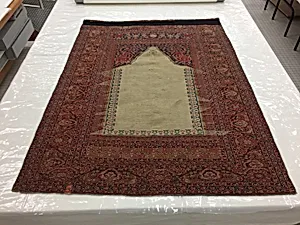
Prayer Rug with Niche Design
Unknown Artist
late 18th–early 19th century
Medium
Wool (warp, weft, and pile), cotton (pile); symmetrically knotted pile
Dimensions
L. 64 in. (162.6 cm) W. 49 in. (124.5 cm)
Classification
Textiles-Rugs
Department
Islamic Art
Museum
Metropolitan Museum of Art, New York, NY
Credit
Gift of Thomas Colville, 2019
Accession Number
2019.480
Rights
Public Domain
Art Historical Context
This exquisite *Prayer Rug with Niche*, crafted in the late 18th to 19th century, the artistry of Islamic textile traditions. Woven from wool for the warp, weft, and pile, with cotton accents in the pile, it an impressive 64 by 49 inches—perfectly sized for personal devotion. The central niche, or *mihrab*, mimics the arched prayer alcove in a mosque, directing the worshipper toward Mecca during *salat* (daily prayers). Such rugs were essential household items in Ottoman or Anatolian Muslim homes, blending spirituality with everyday life. The rug's symmetrically knotted pile technique, a hallmark of fine Anatolian weaving, allowed for intricate patterns and durability. Each knot, tied by hand, creates a plush surface that withstands repeated use while showcasing geometric motifs and floral borders typical of the period. These designs not only beautified the space but also symbolized paradise gardens, reflecting Islamic cosmology. Generously gifted to the Metropolitan Museum of Art by Thomas Colville in 2019, this anonymous masterpiece invites visitors to appreciate the anonymous skill of its makers. It stands as a testament to the cultural richness of Islamic art, where functionality meets profound aesthetic and religious depth.