
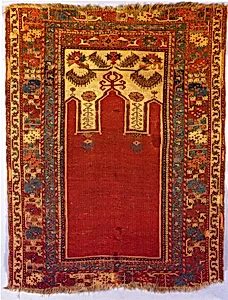
Prayer Rug with Triple Arch Design
Unknown Artist
probably late 18th century
Medium
Wool (warp, weft, and pile); symmetrically knotted pile
Dimensions
L. 56 in. (142.2 cm) W. 43 in. (109.2 cm)
Classification
Textiles-Rugs
Department
Islamic Art
Museum
Metropolitan Museum of Art, New York, NY
Credit
Gift from the Collection of Hillary Black Dumas and Dr. D. Gilbert Dumas, 2009
Accession Number
2009.458.11
Rights
Public Domain
Art Historical Context
This exquisite **Prayer Rug with Triple Arch**, likely woven in the late 18th, exemplifies the artistry of Islamic textile traditions. Crafted from wool for warp, weft, and pile, it features a classic mihrab motif—a recessed niche depicted with three graceful arches—that symbolizes the qibla, the direction of Mecca faced during Muslim prayer. Such rugs, known as sajjada, were essential personal devotional objects, transforming any space into a sacred one for the five daily prayers. The rug's symmetrically knotted pile technique, a hallmark of Ottoman and Anatolian weaving, allowed for intricate patterns and exceptional durability. Each knot, tied mirror-image across the width, created a dense, velvety surface ideal for kneeling in worship. Measuring 56 by 43 inches, it was sized for individual use, its vibrant colors and geometric motifs reflecting the weaver's mastery of balance and symmetry. A generous gift to the Metropolitan Museum of Art in 2009 from the Collection of Hillary Black Dumas and Dr. D. Gilbert Dumas, this anonymous masterpiece invites visitors to appreciate the fusion of spirituality, craftsmanship, and cultural heritage in Islamic art.