
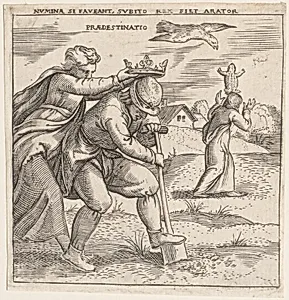
Predestination
ca. 1545–50
Medium
Engraving
Dimensions
sheet: 3 1/8 x 3 1/16 in. (8 x 7.8 cm) trimmed just outside platemark
Classification
Prints
Department
Drawings and Prints
Museum
Metropolitan Museum of Art, New York, NY
Credit
The Elisha Whittelsey Collection, The Elisha Whittelsey Fund, 1949
Accession Number
49.97.381
Rights
Public Domain
Tags
Art Historical Context
Created around 1545–50 by the Italian engraver Enea Vico, *Predestination* exemplifies the refined printmaking tradition of the mid-Renaissance. Vico, active in Venice and later at the Medici court, was celebrated for his precise burin work that translated complex ideas into portable images. This small engraving, measuring just over three inches, demonstrates the period’s growing interest in allegory, with its composition featuring men, women, and eagles—symbols often linked to power, vision, and divine will. Engraving allowed artists like Vico to reach wider audiences beyond elite collectors, spreading iconographic themes across Europe at a time when print culture was rapidly expanding. The compact format suggests the work may have been intended for inclusion in books or personal collections, underscoring how such prints functioned as both art and intellectual currency. Today housed in the Metropolitan Museum’s Department of Drawings and Prints, *Predestination* invites viewers to consider how Renaissance artists used symbolic language to explore fate and human agency. Its delicate lines and balanced design continue to reward close looking, revealing the technical mastery that made engraving a vital artistic medium of its era.
About the Artist
Enea Vico · 1523–1567
Enea Vico (1523–1567) was born in Parma and came of age during the final, energetic decades of Italian Renaissance printmaking. By 1541 he had made his way to Rome, where he entered the orbit of the engraver and publisher Tommaso Barlacchi and began his professional career. In Rome, Vico encountered the work of the most celebrated printmakers of the preceding generation—Marcantonio Raimondi, Agost...