
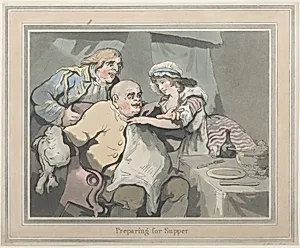
Preparing for Supper
1790?
Medium
Hand-colored etching and aquatint
Dimensions
Sheet: 8 7/16 × 10 3/8 in. (21.4 × 26.3 cm)
Classification
Prints
Department
Drawings and Prints
Museum
Metropolitan Museum of Art, New York, NY
Credit
The Elisha Whittelsey Collection, The Elisha Whittelsey Fund, 1959
Accession Number
59.533.379
Rights
Public Domain
Tags
Art Historical Context
Thomas Rowlandson's *Preparing for Supper* (c. 1790) is a delightful hand-colored etching and aquatint that captures the bustling chaos of a domestic scene in late 18th-century Britain. Rowlandson, a master of caricature and satire during the Georgian era, delighted audiences with his witty observations of everyday life, often poking fun at social pretensions and human folly. This print, from the Metropolitan Museum of Art's Elisha Whittelsey Collection, measures a modest 8 7/16 × 10 3/8 inches, making it an intimate glimpse into the world of servants and their masters. The artwork humorously depicts men, women, and servants in the frenzied preparations for a meal, highlighting the class dynamics and comedic mishaps of dining rituals. Rowlandson's satirical edge shines through, likely exaggerating the awkward interactions between upstairs and downstairs worlds—a common theme in his oeuvre, which critiqued the excesses of British society amid the Industrial Revolution's social shifts. Technically, the hand-coloring brings vivid life to the aquatint's tonal washes, allowing for rich textures in fabrics and expressions that enhance the farce. As a print, it was affordable and widely circulated, democratizing Rowlandson's sharp social commentary for a broad public. A charming reminder of 18th-century manners!
About the Artist
Thomas Rowlandson · 1756–1827
Thomas Rowlandson (1757–1827) was an English artist and caricaturist whose satirical watercolors and prints captured the social life of Georgian Britain with unparalleled wit and technical mastery. Alongside James Gillray, he is recognized as one of the greatest British graphic artists, and his distinctive flowing line and keen observations have made his work integral to understanding late 18th an...