
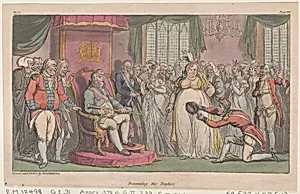
Presenting the Trophies
Medium
Hand-colored etching and aquatint
Dimensions
Sheet: 4 15/16 × 7 5/8 in. (12.5 × 19.3 cm)
Classification
Prints
Department
Drawings and Prints
Museum
Metropolitan Museum of Art, New York, NY
Credit
The Elisha Whittelsey Collection, The Elisha Whittelsey Fund, 1959
Accession Number
59.533.1623(16)
Rights
Public Domain
Tags
Art Historical Context
"Presenting the Trophies a hand-colored etching and aquat from 1815 by British caricaturist Thomas Rowland in collaboration with Patrick Martin &., captures a lively moment amid the euphoria following Napoleon's defeat at Waterloo Measuring just 4 15/16 × 7 5/8 inches, this intimate print belongs to the Metropolitan Museum of Art's Elisha Whittelsey Collection. Rowlandson, a master of satirical humor during the Regency era, often depicted everyday life with exaggerated wit, blending etching's sharp lines with aquatint's subtle tonal gradients for depth and vibrancy. The hand-coloring adds a playful, vivid charm, making these affordable prints highly sought after by 19th-century collectors. The scene likely shows soldiers proudly displaying captured "trophies"—perhaps French flags or spoils of war—to admiring women and fellow men, reflecting Britain's triumphant spirit in 1815. This artwork embodies the cultural zeitgeist of post-Napoleonic celebration, where military victories fueled patriotic satire. Rowlandson's style, rooted in the caricature tradition, pokes fun at human vanity and revelry, offering a window into Regency social dynamics. A delightful piece for visitors, it reminds us how art turned historic triumphs into accessible, entertaining narratives.
About the Artist
Thomas Rowlandson|Patrick Martin & Co · 1756–1827
Thomas Rowlandson (1757–1827) was an English artist and caricaturist whose satirical watercolors and prints captured the social life of Georgian Britain with unparalleled wit and technical mastery. Alongside James Gillray, he is recognized as one of the greatest British graphic artists, and his distinctive flowing line and keen observations have made his work integral to understanding late 18th an...