
Preserve Jar
c. 1940
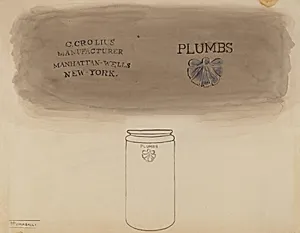
Medium
watercolor and graphite on paperboard
Dimensions
overall: 22.5 x 28.9 cm (8 7/8 x 11 3/8 in.) Original IAD Object: 9" High 4 3/4" Dia(base) 4" Dia(top)
Classification
Index of American Design
Department
CG-W
Museum
National Gallery of Art, Washington, D.C.
Credit
Index of American Design
Accession Number
1943.8.7450
Rights
Public Domain
Art Historical Context
In the Preserve Jar, created around 1940 by Chicago-based artist Frank Fumagalli, visitors encounter a meticulous watercolor and graphite rendering on paperboard that captures the humble elegance of an everyday American artifact. Measuring 22.5 x 28.9 cm, this work depicts a glass jar originally standing 9 inches high with a 4¾-inch base diameter tapering to 4 inches at the top—likely used for storing fruit preserves in early 20th-century households. Fumagalli's precise lines and subtle color washes highlight the jar's graceful curves, flared mouth, and subtle pontil mark, evoking the craftsmanship of American glassmakers. This piece is a gem from the Index of American Design, a Federal Art Project of the Works Progress Administration (WPA) launched in 1935 amid the Great Depression. Over 18,000 artists like Fumagalli documented folk art, crafts, and design objects to celebrate and preserve the nation's cultural heritage. By rendering three-dimensional items with scientific accuracy, these works served as both artistic expression and historical record, ensuring that vernacular treasures like this jar—symbols of domestic ingenuity—endured beyond their fragile physical forms. Housed in the National Gallery of Art's collection, the Preserve Jar invites us to appreciate how ordinary objects reflect broader stories of American resilience and creativity, bridging art, history, and everyday life.
About the Artist
Frank Fumagalli · 1895–1958
Frank Fumagalli (c. 1895–1958) was an Italian-born American artist whose precise watercolor renderings captured the essence of everyday American folk art objects during the mid-20th century. Little is known about his early life and training, as biographical details remain scarce beyond his immigration from Italy and establishment in the United States. Active primarily in New York, Fumagalli gained...