
Prie-Dieu
c. 1770–75
Medium
Boxwood and ebony
Dimensions
86.7 × 77.8 × 58.5 cm (34 1/8 × 30 5/8 × 23 in.)
Classification
furniture
Department
Applied Arts of Europe
Museum
Art Institute of Chicago
Accession Number
179971
Rights
Public Domain
About this artwork
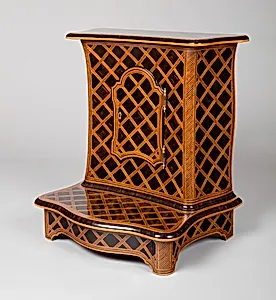
The surface of this prie-dieu—a kneeling bench used for prayer—is inlaid with an intricate, geometric veneer of boxwood and ebony. This complex marquetry design over the prie-dieu’s undulating facade attests to the high degree of technical skill that was the hallmark of cabinetmakers at the royal court of Savoy at Turin in what is now Italy. A door in the center of the prie-dieu conceals a small cabinet for a rosary and prayer books, and the drawer at the base would have held a padded cushion to...
Art Historical Context
This elegant prie-dieu, or prayer desk, was crafted around 1770–75 by Giovanni Battista Galletti in boxwood and ebony. Designed for private devotion, the piece allowed worshippers to kneel in prayer while resting a book or elbows on its slanted surface. Its refined proportions and contrasting woods highlight the high level of skill required to shape durable, finely grained materials into functional furniture. As a work of applied arts from Europe, the prie-dieu reflects the period’s blend of utility and artistry. Boxwood provided a pale, smooth surface ideal for delicate carving, while ebony offered rich dark accents that emphasized form and detail. Such pieces were often commissioned for aristocratic or ecclesiastical settings, underscoring the importance of personal piety in daily life during the late eighteenth century. Today housed in the Art Institute of Chicago’s collection of European applied arts, this compact yet stately object invites visitors to imagine its quiet role in eighteenth-century spiritual practice. Its survival speaks to both the quality of its construction and the enduring cultural value placed on objects that marry beauty with devotion.