
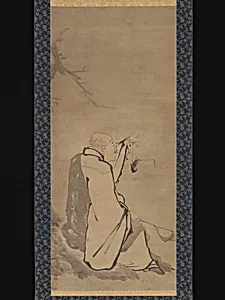
雲谷等顔筆 蜆子和尚図|Priest Xianzi
second half 16th century–early 17th century
Medium
Hanging scroll; ink on silk
Dimensions
Image: 42 1/2 × 18 11/16 in. (108 × 47.4 cm) Overall with knobs: 74 1/8 × 25 3/4 in. (188.3 × 65.4 cm)
Classification
Paintings
Culture & Period
Japan · Momoyama period (1573–1615)
Department
Asian Art
Museum
Metropolitan Museum of Art, New York, NY
Credit
Mary and Cheney Cowles Collection, Gift of Mary and Cheney Cowles, 2019
Accession Number
2019.420.10
Rights
Public Domain
Tags
Art Historical Context
In the vibrant Momoyama period (1573–1615), a time of bold artistic experimentation in Japan amid samurai culture and castle-building fervor, Unkoku Tōgan crafted this striking hanging scroll, *Priest Xianzi*. Tōgan (1547–1616), a master of the Unkoku school, drew from the legacy of ink-painting pioneer Sesshū Tōyō, blending Zen-inspired minimalism with dynamic brushwork. This portrait, signed "Unkoku Tōgan's brush," captures the eccentric Chinese monk Priest Xianzi (蜆子和尚), evoking the playful yet profound spirit of Chan (Zen) Buddhist figures who embodied enlightenment through unconventional wisdom. Rendered in delicate ink on silk—a medium prized for its luminous sheen and ability to hold subtle gradations—the 42½ × 18⅝-inch image unfolds as a vertical hanging scroll, ideal for meditative display in a temple alcove or tea room. Tōgan's economical lines and textured washes highlight the monk alongside crayfish, symbols perhaps alluding to impermanence or the monk's legendary affinity for humble river creatures. Such motifs reflect Momoyama ink painting's fusion of Chinese literati traditions with Japanese wit, making this work a gem of suiboku-ga (water-ink) artistry. Now in the Metropolitan Museum of Art's Asian Art collection, gifted by Mary and Cheney Cowles in 2019, *Priest Xianzi* invites visitors to ponder Zen paradoxes: the sacred in the ordinary, rendered with Tōgan's masterful restraint.
About the Artist
Unkoku Tōgan · 1547–1618
Japanese, 1547–1618