
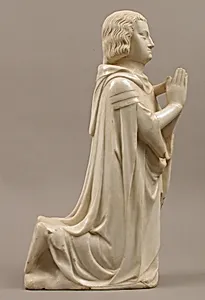
Prince, from a group of Donor Figures including a King, Queen, and Prince
Unknown Artist
ca. 1350
Medium
Marble, traces of paint & gilding
Dimensions
Overall: 14 7/8 x 8 7/8 x 3 1/8 in. (37.8 x 22.5 x 7.9 cm)
Classification
Sculpture-Stone
Culture
French
Department
Medieval Art
Museum
Metropolitan Museum of Art, New York, NY
Credit
Gift of J. Pierpont Morgan, 1917
Accession Number
17.190.392
Rights
Public Domain
Tags
About this artwork
This marble sculpture of a prince, created around 1350 by an unknown French artist, originally formed part of a donor group including a king, queen, and prince, likely commissioned to decorate a church or chapel. Measuring 14⅞ by 8⅞ by 3⅛ inches and retaining traces of original paint and gilding, the figure exemplifies Gothic sculpture's refined naturalism and spiritual intensity. Donor figures represented the patrons who commissioned religious artworks, depicting them in attitudes of prayer or ...
Art Historical Context
This exquisite marble sculpture depicts a prince from a donor group that also included a king and queen, crafted by an unknown French artist around1350. Standing just under 15 inches tall, the figure captures the refined naturalism of late Gothic sculpture, with the prince shown in a devotional pose—likely kneeling in prayer—intended for a church or chapel altar. figures like this represented wealthy patrons who commissioned religious artworks, allowing them to eternally witness sacred while displaying their dynastic prestige and. Traces of original paint andilding on the marble reveal the sculpture's once-vibrant colors, challenging our modern image of stark white medieval stone. Gothic artists excelled at conveying individual character through subtle details in pose, costume, and expression, blending spiritual intensity with elegant realism. Though now separated from its group, this piece highlights how such works served both worldly status and profound faith. A gift from financier J. Pierpont Morgan to the Metropolitan Museum of Art in 1917, it reflects early 20th-century American passion for medieval treasures, preserving a window into 14th-century French devotion and artistry.