
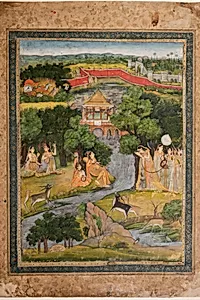
Princess Nurjahan and Attendants
Unknown Artist
18th century
Medium
Opaque watercolor on paper
Dimensions
H. 11 3/4 in. (29.8 cm) W. 8 5/8 in. (21.9 cm)
Classification
Codices
Department
Islamic Art
Museum
Metropolitan Museum of Art, New York, NY
Credit
Rogers Fund, 1948
Accession Number
48.83
Rights
Public Domain
Tags
Art Historical Context
This exquisite 18th-century opaque watercolor on paper, titled *Princess Nurjahan andendants*, offers a glimpse into the opulent world of Mughal courtly life. Nurjahan, the influential empress and wife of Emperor Jahangir the early 17th century, is depicted here in a later illustration, surrounded by elegant women, musicians, and even a graceful deer. The intimate scene, filled with music and leisure, evokes the refined pleasures of royal women in Islamic South Asia, blending historical reverence with artistic fantasy. As a page from a codex—likely part of an illuminated manuscript—this work captures the narrative tradition of Persianate storytelling, where such vignettes adorned books of history, poetry, or legend. Rendered in the meticulous style of Mughal miniatures, the painting employs vibrant opaque watercolors to create jewel-like details: flowing garments, expressive faces, and harmonious compositions within its compact 11 3/4 x 8 5/8-inch frame. This technique, rooted in Persian influences but distinctly Indian, allowed artists to layer rich pigments for luminous effects, emphasizing texture and symbolism—like the deer, perhaps symbolizing gentleness or paradise gardens. Housed in the Metropolitan Museum of Art's Islamic Art Department (Rogers Fund, 1948), this anonymous masterpiece highlights the cultural prestige of women in Mughal society and the enduring appeal of miniature painting. Visitors will appreciate its delicate beauty, a window into a bygone era of imperial splendor.