
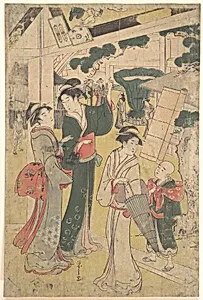
Medium
Woodblock print; ink and color on paper
Dimensions
Image: 14 3/4 × 9 7/8 in. (37.5 × 25.1 cm)
Classification
Prints
Culture & Period
Japan · Edo period (1615–1868)
Department
Asian Art
Museum
Metropolitan Museum of Art, New York, NY
Credit
Museum Accession
Accession Number
JP1096a
Rights
Public Domain
Tags
Art Historical Context
This exquisite woodblock print by Chōbunsai Eishi, a master of the Edo period (1615–1868), captures vibrant world of ukiyo-e, or "pictures of the floating." Created using ink and color on paper the medium exemplifies the collaborative artistry of Japanese printmaking: designers like Eishi sketched the compositions, carvers shaped wooden blocks, and printers applied pigments in precise layers for luminous effects. Measuring 14 3/4 × 9 7/8 inches, its intimate scale made it ideal for affordable dissemination among urban dwellers in Edo (modern Tokyo), democratizing art during Japan's prosperous Tokugawa era. Eishi, renowned for his refined bijin-ga (images of beautiful women), often infused his works with graceful figures and subtle emotional depth, distinguishing him from bolder contemporaries like Utamaro. The tags—boys, men, and women—suggest a genre scene from everyday life or entertainment, reflecting Edo society's fascination with human relationships, theater, and leisure. Woodblock prints like this one were cultural touchstones, adorning homes and fueling a booming publishing industry that influenced global art, from Impressionism to modern design. Housed in the Metropolitan Museum of Art's Asian Art Department, this print invites us to savor the elegance of a bygone era, where artistry met mass appeal.
About the Artist
Chōbunsai Eishi · 1756–1829
Japanese, 1756–1829