
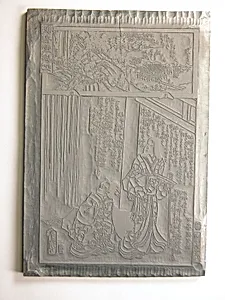
Printer's woodblock
18th–19th century
Medium
Wood
Dimensions
15 1/2 x 10 1/2 in. (39.4 x 26.7 cm)
Classification
Woodblocks
Culture
Japan
Department
Asian Art
Museum
Metropolitan Museum of Art, New York, NY
Credit
Gift of Mrs. Howard Mansfield, 1949
Accession Number
49.46.1
Rights
Public Domain
Tags
Art Historical Context
This printer's woodblock, crafted by Utagawa Toyok I in 18th–19th Japan, offers a rare glimpse into the behind-the-scenes artistry of ukiyo-e, the "pictures of the floating world" that captured fleeting pleasures of Edo-period life. Toyokuni I, a figure in the Utagawa school, was renowned for his vibrant depictions of beautiful women (bijin-ga) and kabuki actors, often set against evocative landscapes. Measuring 15½ × 10½ inches, this wooden block—likely carved to print scenes of women amid scenic backdrops—highlights the collaborative genius of ukiyo-e production, where artists like Toyokuni designed images passed to master carvers and printers. Woodblock printing revolutionized Japanese art by enabling affordable, colorful mass production. Intricate details were incised in reverse onto cherry wood, inked with pigments, and pressed onto paper in precise layers for multicolored effects. This technique democratized beauty, bringing Toyokuni's elegant figures and lush landscapes to everyday viewers. Donated to the Metropolitan Museum of Art in 1949 by Mrs. Howard Mansfield, the block preserves not just an image, but the very tool that fueled Japan's golden age of printmaking, bridging art and craft in profound cultural harmony.
About the Artist
Utagawa Toyokuni I · 1777–1835
Japanese, 1777–1835