
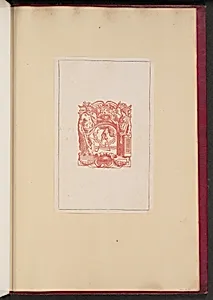
Printer's Device for the Plantin Press
Medium
woodcut in red on laid paper [proof]
Classification
Department
CG-E
Museum
National Gallery of Art, Washington, D.C.
Credit
William B. O'Neal Fund
Accession Number
1996.78.77
Rights
Public Domain
Art Historical Context
**Printer's Device for the Plantin Press** *Christoffel Jegher after Sir Peter Paul Rubens, 1613/1646* *Woodcut in red on laid paper (proof), National Gallery of Art, William B. O'Neal Fund* Step into the world of Renaissance printing with this striking printer's device, a custom emblem designed by the Baroque master Sir Peter Paul Rubens for the illustrious Plantin Press in Antwerp. Founded by Christophe Plantin in the 16th century, the press was Europe's premier publishing house, renowned for lavish polyglot Bibles and scholarly works. Rubens, a close collaborator with Plantin’s heirs, crafted this intricate design around 1613, blending his signature dynamic figures—possibly allegories of Faith and Knowledge—with the press's iconic tools like the compass and olive branch, symbolizing precision and peace. Engraver Christoffel Jegher faithfully translated Rubens' vision into a chiaroscuro woodcut, printed here in vivid red ink on laid paper as a rare proof. This technique, mimicking the light-dark contrasts of painting, elevated prints from mere reproductions to artistic feats, showcasing woodblock's potential for bold tonal depth. Dating to around 1646, it reflects Antwerp's golden age of graphic arts, where Rubens' influence bridged painting and printmaking, ensuring the Plantin legacy endured on every book page. A testament to craftsmanship, this proof invites you to admire how emblems like this marked quality in an era before trademarks! (198 words)