
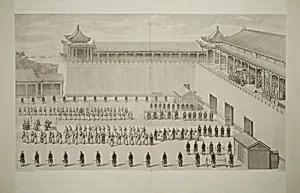
Prisoners Presented to the Emperor
Medium
Etching and engraving
Dimensions
Sheet: 25 3/4 × 39 1/2 in. (65.4 × 100.4 cm) Plate: 22 1/2 × 36 1/2 in. (57.1 × 92.7 cm)
Classification
Prints
Department
Drawings and Prints
Museum
Metropolitan Museum of Art, New York, NY
Credit
Harris Brisbane Dick Fund, 1945
Accession Number
45.100.14
Rights
Public Domain
Tags
Art Historical Context
**Prisoners Presented to the Emperor (1767–74) is a monumental etching and engraving by French artists Charles Nicolas Cochin II Louis Joseph Masquelier and Jean-Denis Attiret. Measuring nearly 40 inches wide, this print from The Metropolitan Museum of Art's and Prints collection captures a dramatic moment of imperial triumph. Attiret, a Jesuit missionary and painter who served at the Qianlong Emperor's in China, provided the original designs based on eyewitness observations, while Cochin II—one of 18th-century France's engravers—and Masquelier translated them into intricate print form. Created amid Qianlong's expansive military campaigns (1735–1796), the scene depicts captured prisoners humbly presented before the enthroned emperor, symbolizing the might of the Qing dynasty. These prints were part of a celebrated series, *Estampes des Conquêtes de l'Empereur de la Chine*, produced to showcase China's victories to European audiences, fostering cultural exchange during the Enlightenment. The etching and engraving techniques allowed for extraordinary detail—from the emperor's ornate robes to the prisoners' chains—reproducing vast compositions with precision unattainable in painting alone. This artwork bridges East and West, blending Chinese subject matter with French Rococo finesse, offering visitors a window into 18th-century imperial power and the artistry of cross-cultural collaboration.